Federal Brick Company
The Federal Brick Company’s main operation was in Alexandria, but in 1906, founder Harry Woodley, decided to open a subsidiary at Hurstville. He moved to Ormonde Parade, where he could watch his Carlton Brickworks being constructed, the suburb wouldn’t be called Allawah until the 1920s.
The brickworks was erected on a paddock formerly owned by the Chappelow family, which had been used for horse racing and was where the cricket club played before Hurstville Oval was laid out.
At its peak, the brickworks was turning out 15 million bricks annually, with four chimneys dominating the local landscape and were said to be visible up to ten miles (16 km) away. The works closed in the mid-1950s, and the four factory chimneys were demolished in 1957, changing the Hurstville skyline.
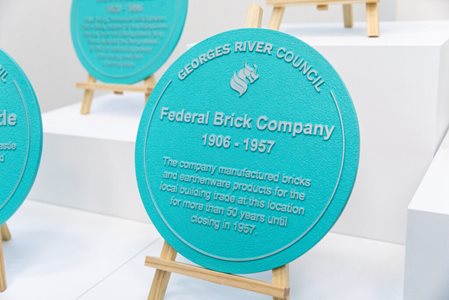
The Historical Marker reads:
Federal Brick Company 1906 - 1957.
The company manufactured bricks and earthenware products for the local building trade at this location for more than 50 years until closing in 1957.
Location of Historical Marker:
Kempt Field, Hurstville.
Location on Google Maps.
Jack Napier Davenport
Prior to WWII Jack Davenport was employed as a bank clerk until he enlisted in 1941. Within a year he had attained the rank of Squadron-Leader, training as a pilot of Beaufighter aircraft with the RAF Coastal Command. Davenport served with No 455 Squadron RAAF over north-west Europe and Russia. By 1944 he had been awarded the Distinguished Flying Cross (DFC), the Distinguished Service Order, and then added another bar to his DFC after earning the medal a second time.
In September 1944 Davenport was awarded a George Medal for saving the life of a pilot whose plane crashed and had burst into flame. Davenport witnessed the crash and drove over to the burning wreck and saw that the pilots cockpit hatch was not properly opening, trapping them inside. Davenport ran towards the conflagration and opened the pilots hatch from the outside and helped free him, carrying him through the flames to safety. In saving the man’s life, Davenport sustained shock, burns to his face, hair and hands. Davenport was the first member of the Coastal Command to be awarded the George Medal.


The Historical Marker reads:
Jack Napier Davenprt DSO, DFC & Bar, GM, MID.
RAAF Wing Commander 455 Squadron (1941-1946), recipient of the Distinguished Service Order and Distinguished Flying Cross. Awarded the George Medal in1945 for outstanding bravery after saving crew from a burning plane.
Location of Historical Marker::
51 Kyle Parade, Blakehurst.
Location on Google Maps.
John Radecki
John Radecki was born in 1865 in Lodz, which was part of Russia at the time but is now located in modern day Poland. His family came to Australia in 1882, where John would attend art classes at Sydney Mechanics’ Institute. In 1888 he married Emma Saunders, and the new couple moved to Hurstville.
John found work with Frederick Ashwin, one of Sydney’s leading stained glass companies, catering to the demand for stained glass windows for the growing number of churches of various denominations in and around Sydney. By 1910, he was chief designer for the company, and later went into partnership with John Ashwin (who inherited the company from his brother Frederick), becoming proprietor of the company by 1920.
Radecki’s work in the Georges River area includes windows in St Patrick’s Kogarah, St Declan’s Penshurst, and St Raphael’s in South Hurstville. Some of his more famous pieces can be found in St Mary’s Cathedral and the Garden Island Naval Chapel. John was a church committee-member of St Declan’s, and donated a memorial window there dedicated to his first wife, who died in 1919. John Radecki died at Hurstville in 1955, and his daughter continued the company for a few years after his death.


The Historical Marker reads:
John Radecki 1865 - 1955.
A Polish immigrant and former coal miner who became the first stained glass artist to be trained in NSW. His work can be found across NSW including at the Mitchell Library and here at St Raphael’s Church.
Location of Historical Marker:
St Raphael's.
George Street, South Hurstville.
Location on Google Maps.
Ruth Staples
Ruth Staples, nee Haworth, worked tirelessly for many years to ensure the survival of the natural environment at Lime Kiln Bay. The Lime Kiln Bay wetland and the bush to the west were threatened by various agencies in the 1970s, and their preservation owes much to her campaigning, along with David Koffel and the Lime Kiln Bay Preservation Committee.
Ruth was widowed in 1970 when her husband Mick died suddenly. She was then retraining to be a teacher, and it was obvious to her that there was huge educational and social value in preserving bushland surroundings. At the time Hurstville Council had problems disposing of their rubbish and was considering converting the wetlands into a landfill, and in the process extend the golf course. The Lime Kiln Bay Preservation Committee lobbied hard to persuade them of the importance of the wetlands, and their alternative vision largely prevailed, resulting in the preservation of much of the natural bushland around the upper reach of Lime Kiln Bay and Dairy Creek.


The Historical Marker reads:
Ruth Staples 1930 - 2020.
A founding member of the Lime Kiln Bay Preservation Committee that protected nearby natural places including the wetlands and Dairy Creek.
Location of Historical Marker:
Lime Kiln Bay Circuit Walk,
Lime Kiln Bay Reserve, Oatley.
Location on Google Maps.
Silvester’s Castle
Henry Silvester was born in England in 1863. He migrated (?) to Australia and with his brother and founded the Silvester Brothers smallgoods manufacturing company, based at Redfern. He came to live at Oatley in 1907, and began construction of what he intended to become his very own castle.
He brought in Italian stonemasons to cut beautiful blocks of sandstone for his castle, which would have had a spectacular outlook over the Georges River. The stone was quarried on site, and in places it rose to two storeys high. There was a small tower and a cellar known by local children as a ‘dungeon’. The building was ringed by a concrete-lined moat, and had a stone wall roughly 200 metres long. Construction began strongly, but petered out when World War One began. The site was unguarded, and prone to being damaged and by the 1920s had become a playground for the youngsters of Oatley.
After Silvester’s death in 1935 the castle was gradually dismantled, and apparently some of the stonework has found its way into the gardens and structures of various locals throughout Oatley.


The Historical Marker reads:
Silvester's Castle.
Henry C Silvester tried to build a castle here during WWI but abandoned construction in the 1920s. Children played in the ruins and traces of stonework can be found nearby.
Location of Historical Marker:
Corner of Yarran Road and Southern Street, Oatley.
Location on Google Maps.
Thank you for taking the time to share your feedback.