Shipwrights Bay
The land we call Shipwrights Bay is the traditional land of the Bidjigal people, and contains rock shelters, shell middens and carvings; which are heritage listed. The site was later used for shipbuilding activities, which is likely where the name derives from.
Shipbuilding in the area can be traced to the 1870s and a man named George Henry Whittingstall. Whittingstall served with the Royal Navy, moving to Sydney in 1872 and married in Rockdale the following year. In his obituary it is noted that he built a schooner at Shipwrights Bay, the first record of any ship works that took place in the area.


The Historical Marker reads:
Shipwrights Bay.
The Traditional Custodians of this place are the Bidjigal people and they fished and sheltered here along the foreshore. In the 1870s the area was logged by European settlers and used for shipbuilding activities
Location of Historical Marker:
Entrance to Shipwrights Bay Reserve,
Woodlands Avenue, Blakehurst.
Location on Google Maps.
St Clair Recording Studio 1965-1966
The St Clair Recording Studio was established by Oswald ‘Ossie’ Russell Byrne in Hurstville in 1965 after previously running his studio out of his family home in Wollongong in the late 1950s. Operating out of a strip mall at 56 Queens Road, Byrne’s studio had concrete floors and used old carpets and mattresses for soundproofing. And yet despite this humble setup, St Clair was graced by the sounds of many talented Australian artists.
The studio was keenly sought by bands as it operated with two mono recorders, the leading technology of the time. The Bee Gees, recorded their early work at the studio, including their breakthrough hit “Spicks and Specks” in 1966. The Bee Gees Rare Precious and Beautiful was the first ever LP recorded in Australia and was produced at St Clair Studio in 1966. This was also the location where popular Australian TV show “Bandstand” recorded backing tracks in 1966. Other artists to record at St Clair included The Twilights, MPD Ltd and Ronnie Burns. St Clair Recording Studio was short lived and after closing the building in which it was held was demolished in the 1970s.

The Historical Marker reads:
St Clair Recording Studio. 1965 - 1966.
Ossie Byrne opened a popular studio on this site behind a butcher's shop. The Bee Gees recorded the international hit "Spicks and Specks" here in 1966.
Location of Historical Marker:
56 Queens Road, Hurstville NSW.
Location on Google Maps.
Amy Bertha York
Mrs Amy York, nee Hirsch, was born in 1894 in Hay. In 1917, at the age of 23, she married Albert York, a builder, in Balmain. By 1930, the couple were living at Oatley, and would later move to Peakhurst. While women were allowed to stand for municipal council from 1918, Amy York became only the second woman to stand for election to Hurstville Council in 1944, following the pioneering example of Jessie Saltwell. In the election of December 1944, she polled 889 votes, only 34 votes short of winning a seat. She then contested a by-election in August 1945, losing out to ex-Alderman Olds who had a majority of 306. She did not stand again for Hurstville Council.
York helped establish the first Council provided childcare centre in Hurstville, the Mary Alice Evatt Child Centre, which was later renamed to the Hurstville Child Care Kindergarten Centre. It was created by volunteer fund-raising for which Amy York led the charge. She later became president of the centre in 1947. By 1963 she had moved to Port Macquarie with her husband.


The Historical Marker reads:
Amy Bertha York. 1965 - 1966.
A founder of the St George District Building Society, Mrs York was an advocate for children’s welfare and providing local services to women. She raised funds to establish the area’s first childcare centre on this site in 1947.
Location of Historical Marker:
Corner of Humphrey Lane and Cross Street, Hurstville.
Location on Google Maps.
Sir Jack Brabham AO OBE
Jack Brabham was born at Hurstville on 2 April 1926, where his father Cyril had a fruit shop on Forest Road. Following service in the RAAF, Jack opened an engineering workshop at Mortdale, and began making his name as a driver on the midget car circuits. He also developed great experience in engine design.
He married Betty Beresford in 1951, and they lived for a time at Walter Street, Mortdale. Jack began competing in races in Europe from 1955, and later moved into Formula One racing. In only a few short years he rose through the ranks and became world champion in 1959, and 1960. His expertise in engine design led to him founding the Brabham marque in 1962, and he raced in his own Brabham car to win the 1966 world championship. It is the only time a driver has won the championship in a car he designed himself.
He continued winning Grand Prix races up to 1970, and was knighted in 1978 for services to motorsport. He was Australian of the Year in 1967. Hurstville commemorates him in the street-name Jack Brabham Drive, which runs off Hill Street.


The Historical Marker transcription reads:
Sir Jack Brabham AO OBE. 1926-2014.
The Formula One World Champion (1959, 1960 and 1966) began his lifelong love of engine building here in the 1940s while fixing motorcycles at the back of his childhood home.
Location of Historical Marker:
110 Queens Road, Hurstville.
Location on Google Maps.
Oatley Amateur Swimming Club
Oatley Amateur Swimming Club was formed in January 1927, following the installation of a shark-proof net at Sandy Beach, Oatley by Hurstville Council, to form a safe swimming enclosure.
The club organised a successful carnival on Anniversary Day (January 26) 1927 at which the baths were officially opened. Volunteers from the club organised regular working bees to remove rocks in the swimming pool and maintain the structure. Later, club members built a club room in Myall Street. A turning board was installed in the early 1930s, allowing for longer races to be held. The club held fund-raising dances, an annual picnic, and the annual Carnival, which drew swimmers from a wide area.


The Historical Marker reads:
Oatley Amateur Swimming Club Est. 1927.
The Club has a long association with this area and the local community, holding events continuously at Sandy Beach since 1927.
Location of Historical Marker:
Walkers Promenade,
Sandy Beach, Oatley Park, Oatley.
Location on Google Maps.
Restored Markers
Biddy Giles
Biddy Giles (born Bi-yar-rung) was a Dharawal woman who lived and travelled across the lands either side of the Georges River for her entire life. She was a well-known Aboriginal woman who seasonally lived in the Kogarah Bay and Sans Souci areas.
She acted as a guide to the local area, helping people understand the flora and fauna and edible foods available, as well as sharing her extensive local area and history knowledge.
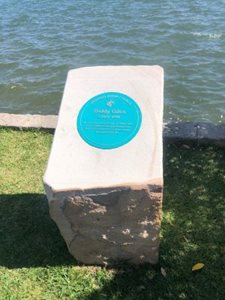
The Historical Marker reads:
Bi-yar-rung, known locally as Biddy Giles, was a Bidjigal/Gweagal woman who shared her extensive local knowledge throughout her life.
Location of Historical Marker:
Endeavour Street Reserve, Sans Souci.
Location on Google Maps.
Thank you for taking the time to share your feedback.